Menu

Gobelins UX Thesis

Gobelins UX Thesis

Gobelins UX Thesis

Master’s thesis and oral defense completed as part of my Master's degree in Digital Project Management & UX Design at Gobelins School (Paris, France).

Master’s thesis and oral defense completed as part of my Master's degree in Digital Project Management & UX Design at Gobelins School (Paris, France).

Master’s thesis and oral defense completed as part of my Master's degree in Digital Project Management & UX Design at Gobelins School (Paris, France).

OVERVIEW

Simplifying e-commerce interfaces to improve focus and experience for users with ADHD

Simplifying e-commerce interfaces to improve focus and experience for users with ADHD

Simplifying e-commerce interfaces to improve focus and experience for users with ADHD

UX RESEARCH PROJECT – GOBELINS PARIS

UX RESEARCH PROJECT – GOBELINS PARIS

Explore how UX can reduce cognitive overload and make digital experiences more inclusive for users with ADHD

15.2/20

UX Thesis Evaluation

7

Recommendations

8

Participants - User test

CLIENT

Gobelins Paris

YEAR

2024/2025

Timeline

8 Months

CLIENT

Gobelins Paris

YEAR

2024/2025

Timeline

8 Months

CLIENT

Gobelins Paris

YEAR

2024/2025

Timeline

8 Months

PROBLEM & RESEARCH QUESTION

How can simplifying e-commerce interfaces through UX Design improve attention and user experience for people with ADHD ?

How can simplifying e-commerce interfaces through UX Design improve attention and user experience for people with ADHD ?

How can simplifying e-commerce interfaces through UX Design improve attention and user experience for people with ADHD ?

Role

UX Researcher · UI Designer

Role

UX Researcher · UI Designer

Role

UX Researcher · UI Designer

CONTEXT

Millions of people with ADHD struggle to stay focused online, often overwhelmed by cluttered interfaces and complex e-commerce flows.

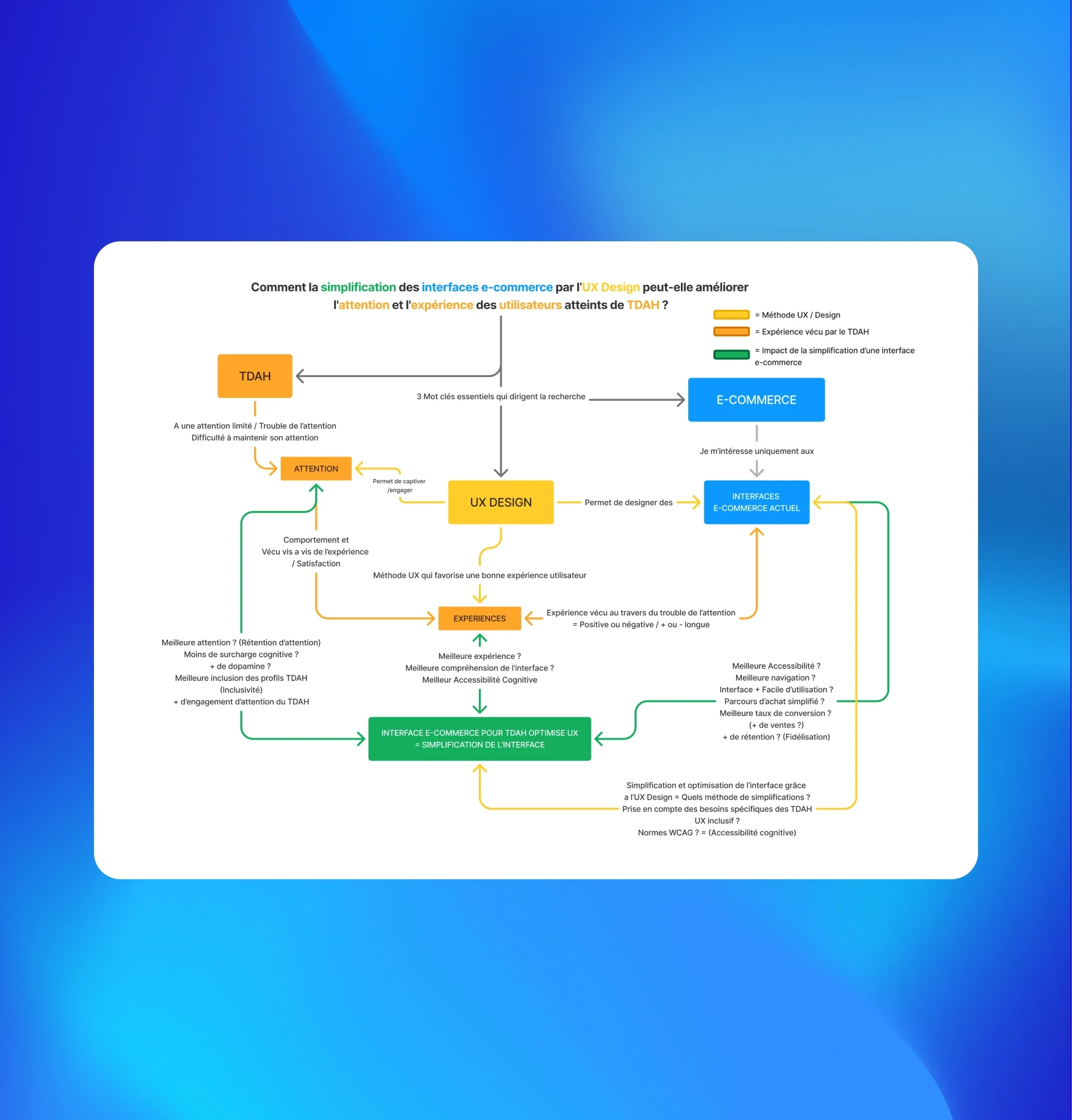
This UX thesis, conducted at Gobelins Paris, explores how thoughtful design can simplify experiences, reduce cognitive load, and keep users engaged drawing on qualitative research and user testing with ADHD participants.

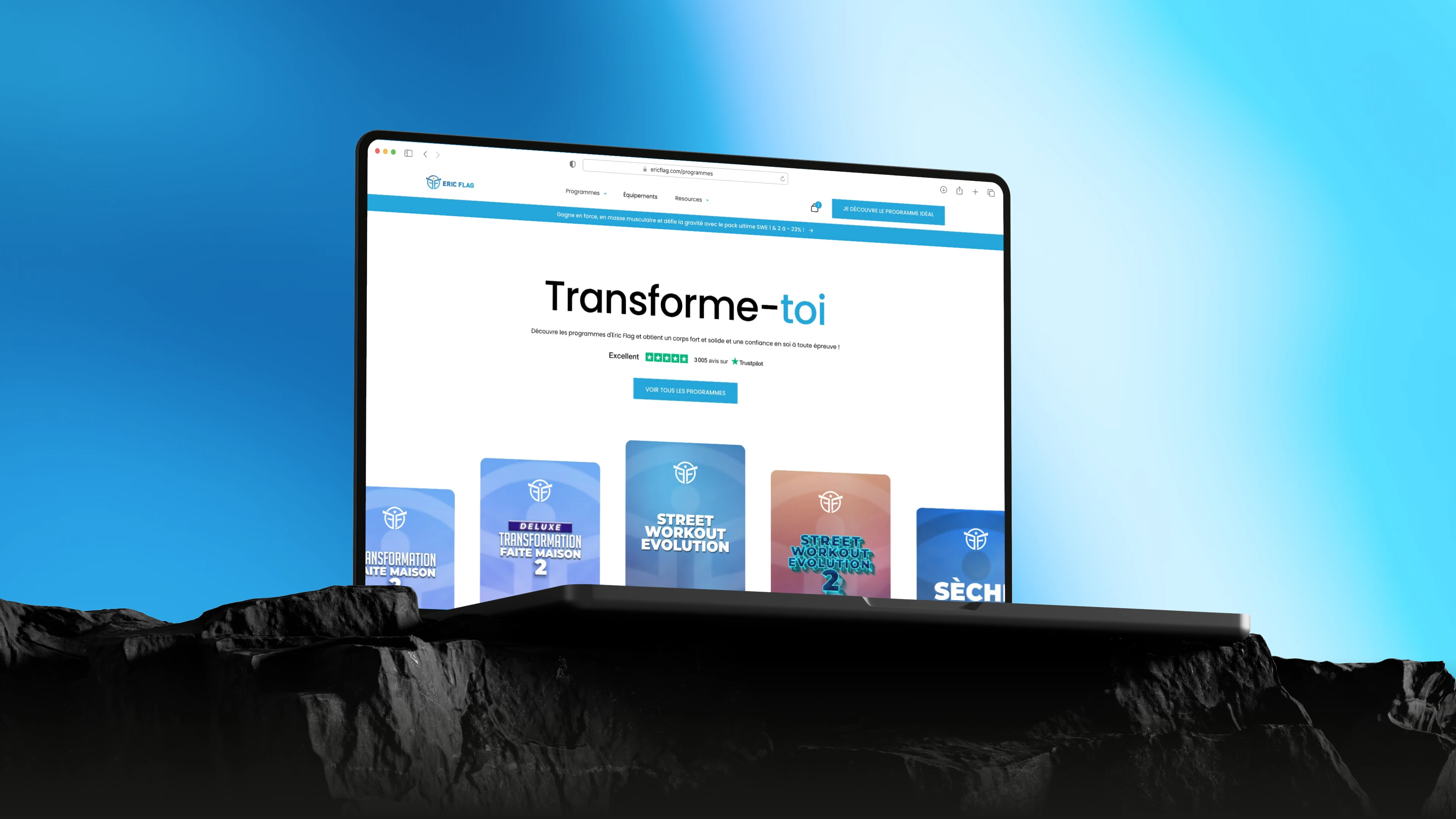
My experience at Eric Flag, a fast-growing e-commerce brand, reinforced that simpler interfaces don’t just support ADHD users, they create better experiences for everyone.

Stack

Figma · Miro · Notion · Zoom

Stack

Figma · Miro · Notion · Zoom

Stack

Figma · Miro · Notion · Zoom

“ Take control of attention with UX that simplifies, guides, and empowers users ”

“ Take control of attention with UX that simplifies, guides, and empowers users ”

“ Take control of attention with UX that simplifies, guides, and empowers users ”

PROBLEM STATEMENT

E-commerce interfaces are often cluttered and cognitively demanding, making it difficult for users with ADHD to stay focused and complete their tasks. This leads to frustration, fatigue, and ultimately a less inclusive user experience.

USER RESEARCH

Research & Insights

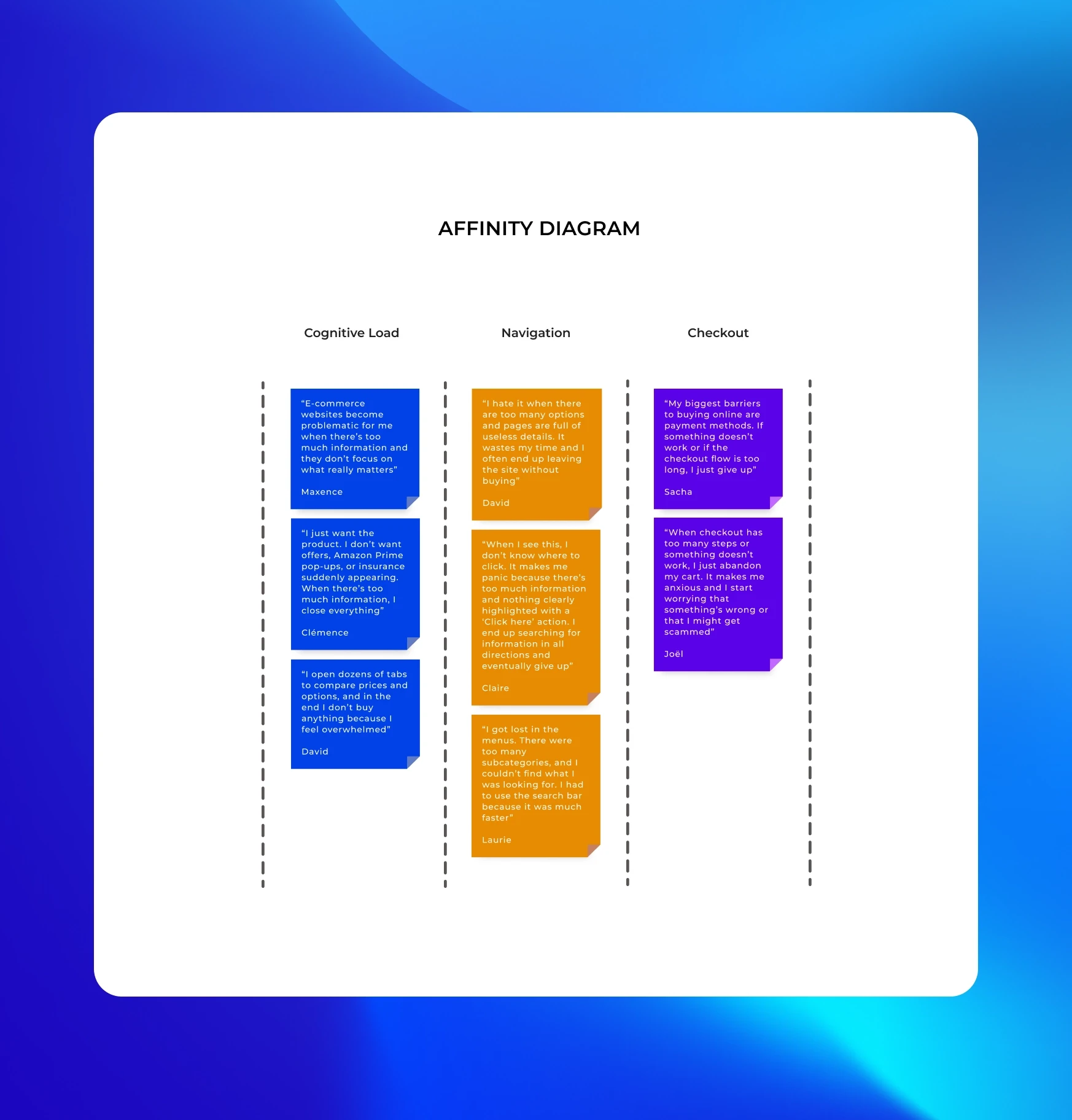
  • " E-commerce websites become problematic for me when there’s too much information and they don’t focus on what really matters "

    Maxence

    User Interview 1

  • " I just want the product. I don’t want offers, Amazon Prime pop-ups, or insurance suddenly appearing. When there’s too much information, I close everything "

    Clémence

    User Interview 2

  • " I hate it when there are too many options and pages are full of useless details. It wastes my time and I often end up leaving the site without buying "

    David

    User Interview 3

  • " My biggest barriers to buying online are payment methods. If something doesn’t work or if the checkout flow is too long, I just give up "

    Sacha

    User Interview 4

  • " E-commerce websites become problematic for me when there’s too much information and they don’t focus on what really matters "

    Maxence

    User Interview 1

  • " I just want the product. I don’t want offers, Amazon Prime pop-ups, or insurance suddenly appearing. When there’s too much information, I close everything "

    Clémence

    User Interview 2

  • " I hate it when there are too many options and pages are full of useless details. It wastes my time and I often end up leaving the site without buying "

    David

    User Interview 3

  • " My biggest barriers to buying online are payment methods. If something doesn’t work or if the checkout flow is too long, I just give up "

    Sacha

    User Interview 4

What we learned and understand about the users ?

To better understand users’ needs and pain points, I conducted user interviews and usability tests. Key insights revealed that users with ADHD struggle to maintain focus when faced with visually overloaded interfaces and unclear task flows.

USER RESEARCH

Research & Insights

USER RESEARCH

Research & Insights

Cognitive Load

Cognitive Load

Analyse how simplified interfaces reduce mental effort for ADHD users

Analyse how simplified interfaces reduce mental effort for ADHD users

Key UX Elements

Key UX Elements

Identify which components maintain or impact focus

Identify which components maintain or impact focus

User Perception

User Perception

Evaluate how ADHD users perceive & use multiple e-commerce interfaces

Evaluate how ADHD users perceive & use multiple e-commerce interfaces

Conversion Impact

Conversion Impact

Measure how simplification affects purchase completion & user's navigation

Measure how simplification affects purchase completion & user's navigation

Cognitive Load

Analyse how simplified interfaces reduce mental effort for ADHD users

User Perception

Evaluate how ADHD users perceive & use multiple e-commerce interfaces

Key UX Elements

Identify which components maintain or impact focus

Conversion Impact

Measure how simplification affects purchase completion & user's navigation

RESEARCH GOALS

PERSONA & METRICS

Maxence

Young adult with ADHD, frequent online shopper

Young adult with ADHD, frequent online shopper

Impulsive buyer

Difficult focus

Confirmed level in E-commerce

Frustrations

Cognitive overload

Unclear Navigation

Weak focus

Long purchase funnels

Based on

01234
00000

People reached

02468

Interviews

00123

Interfaces tested

Cognitive overload leads to abandonment
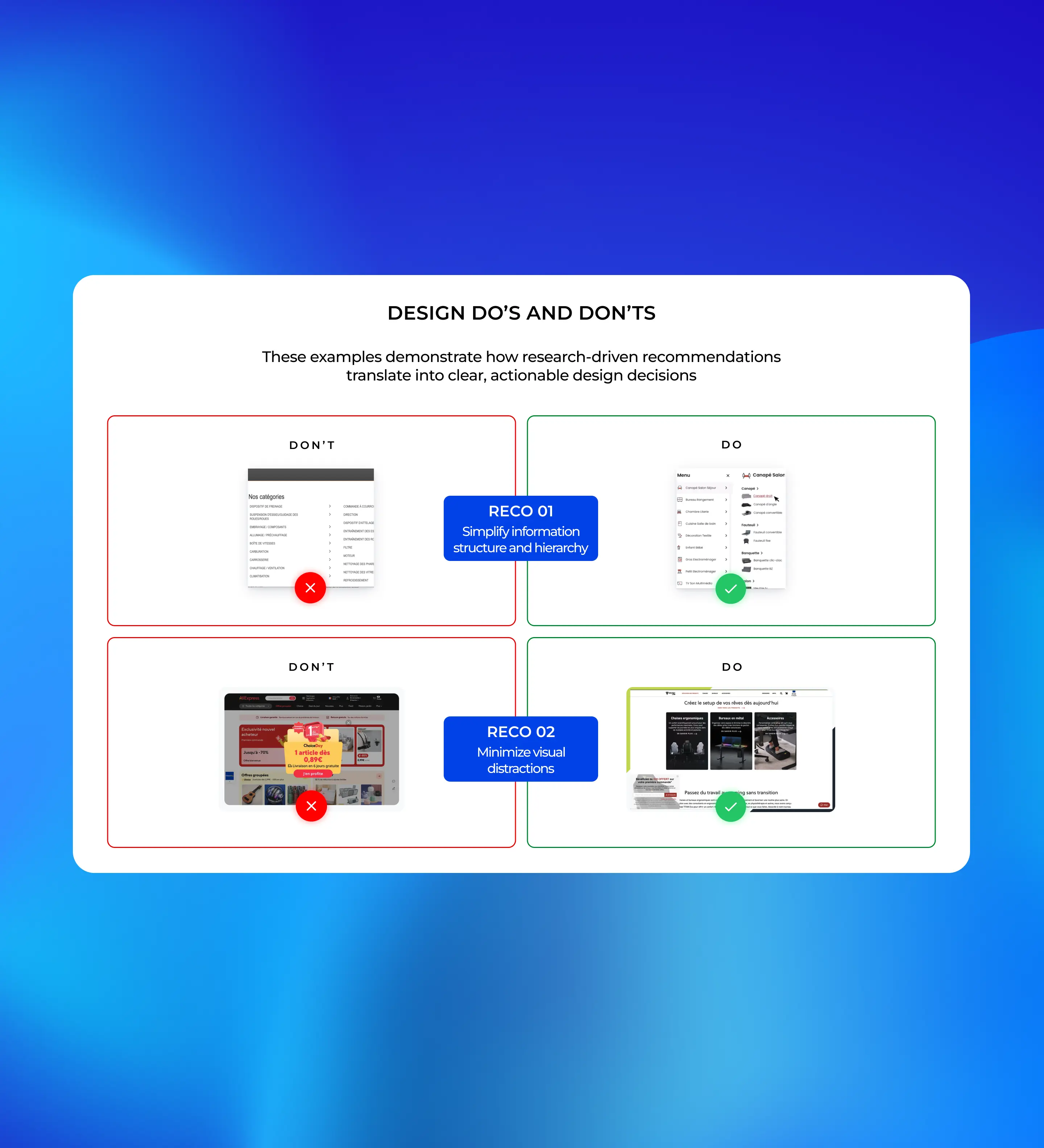
Remove visual distractions and reduce informations
Lack of clear guidance creates navigation confusion
Reinforce visual hierarchy and guide users step by step
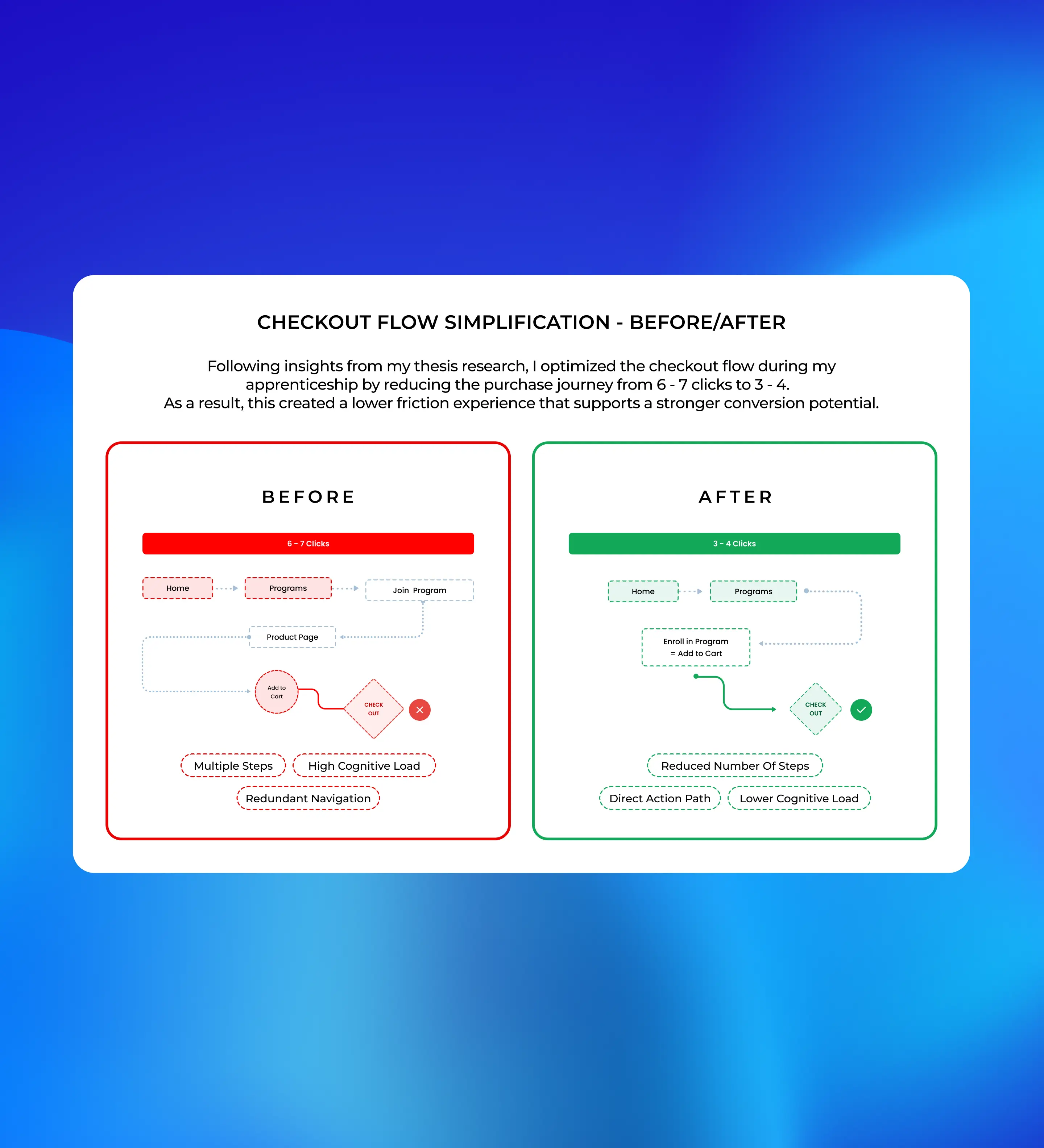
Long and complex checkout flows = friction point
Shorten the purchase path and simplify checkout

KEY INSIGHTS & DECISIONS

  • " E-commerce websites become problematic for me when there’s too much information and they don’t focus on what really matters "
    Maxence

    User Interview 1

  • " I just want the product. I don’t want offers, Amazon Prime pop-ups, or insurance suddenly appearing. When there’s too much information, I close everything "
    Clémence

    User Interview 2

  • " I hate it when there are too many options and pages are full of useless details. It wastes my time and I often end up leaving the site without buying "
    David

    User Interview 3

  • " My biggest barriers to buying online are payment methods. If something doesn’t work or if the checkout flow is too long, I just give up "
    Sacha

    User Interview 4

HOW I APPROACHED THIS PROJECT

Design Process & Methodology

Design Process & Methodology

Design Process & Methodology

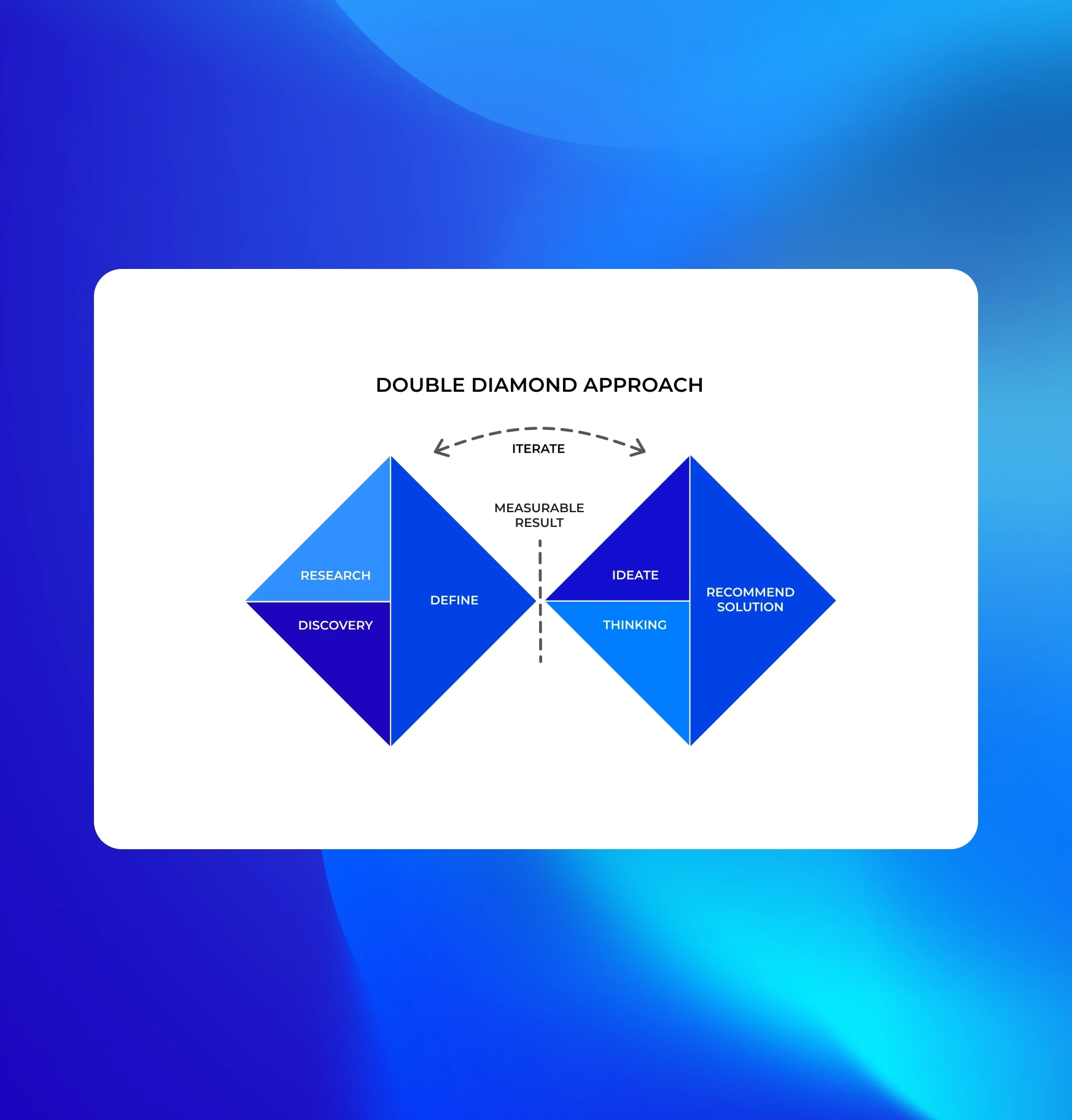
Based on these findings, I followed a Double Diamond approach. Moving from problem definition to ideation, I validated my thinking through user testing with ADHD participants to deliver actionable, user-centered UX recommendations.
  • Brainstorming & Understanding

    01 - Brainstorming

  • Double Diamond

    02 - Double Diamond

  • Affinity Diagram

    03 - Affinity Diagram

  • Brainstorming & Understanding

    01 - Brainstorming

  • Double Diamond

    02 - Double Diamond

  • Affinity Diagram

    03 - Affinity Diagram

  • Brainstorming & Understanding

    01 - Brainstorming

  • Double Diamond

    02 - Double Diamond

  • Affinity Diagram

    03 - Affinity Diagram

DURATION

8 Months

Limits

Solo designer

Limited participant pool

Research bias

Step

01
02
03
04
05

DISCOVER

Problem Definition

Primary & Secondary Research

01

/04

Step

01
02
03
04
05

DISCOVER

Problem Definition

Primary & Secondary Research

01

/04

CASE STUDY - SOLUTION

UX Recommendations

UX Recommendations

UX Recommendations

7 actionable UX recommendations derived from qualitative research and usability testing with 8 ADHD participants
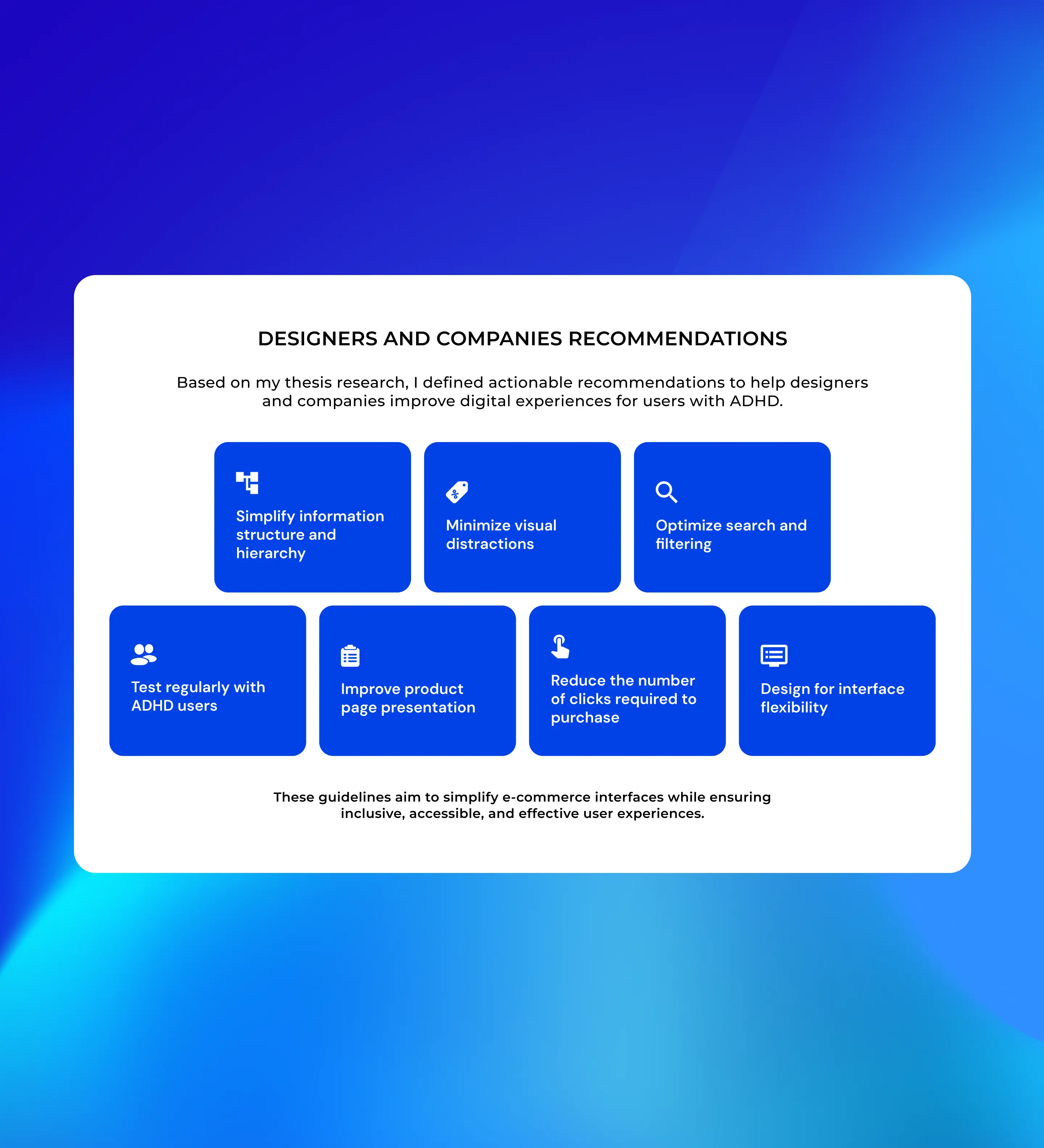
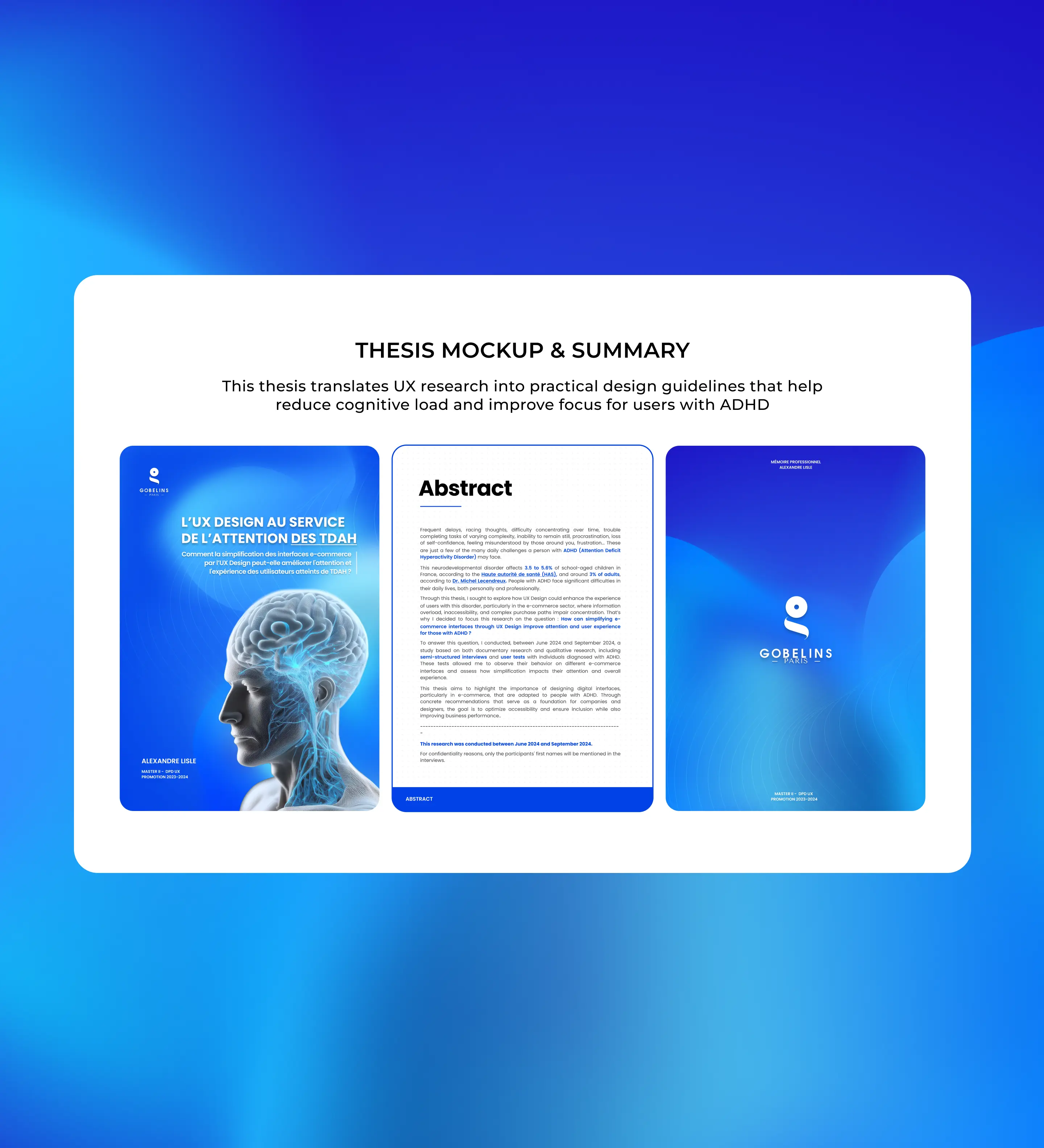
  • Designer's and Company's Recommendations
  • Thesis Mockup & Summary
  • Before/After - Checkout Simplification
  • Design Do's and Don'ts
  • Designer's and Company's Recommendations
  • Thesis Mockup & Summary
  • Before/After - Checkout Simplification
  • Design Do's and Don'ts
  • Designer's and Company's Recommendations
  • Thesis Mockup & Summary
  • Before/After - Checkout Simplification
  • Design Do's and Don'ts

Deliverable

Research Synthesis
UX Recommendations
Checkout Flow Simplification

Expected Outcome

Reduced cognitive load

Users with ADHD complete tasks with less mental effort

Higher task completion rate

Simplified flows reduce drop-off during checkout

Business impact

Lower friction = stronger conversion potential

IMPACT & RESULTS

Outcomes & Impact

Outcomes & Impact

Outcomes & Impact

As this research was not deployed, impact is based on qualitative testing insights and expected product outcomes

Observed User Impact

Based on results with 8 participants across 3 e-commerce interfaces

Cognitive load reduced

Simplified interface scored 2/5 vs 4/5 on MyProtein

Navigation ease

Score 5/5 on the simplified interface

0/8 preferred MyProtein

No participant preferred the most complex interface

Expected Simplification Impact

Lower drop-off

Shorter checkout flow reduces abandonment at each step

Higher task completion

Clear hierarchy helps users reach their goal faster

Better focus

Reduced visual noise keeps ADHD users engaged longer

Key Metrics

0/8

Completed all purchase tasks

0/8

Preferred the simplified interface

-0s

Faster navigation vs complex interface

0→3

Clicks to complete checkout

Metrics Framework

If implemented, success would be measured through :

Conversion rate
Checkout completion rate
Drop-off per step
Time to complete task

Business Value

Simplified interfaces create measurable value beyond accessibility

Fewer clicks

Stronger purchase completion rate

WCAG alignment

Reduces legal risk and expands to users with accessibility needs

Universal benefit

Inclusive design improves usability for all users, not just ADHD

WHAT I’D DO, IMPROVE AND MEASURE IN THE FUTURE

WHAT I’D DO, IMPROVE AND MEASURE IN THE FUTURE

Learnings & Next Steps

Learnings & Next Steps

Learnings & Next Steps

Learning

Key Learnings

Cognitive load is visceral

When overloaded, users don't struggle, they leave

Inclusive design benefits everyone

Every principle applied here improved experience for all user types, not just ADHD users

Simplification is a business argument

Simplified interfaces directly impact conversion rates. Inclusive UX is measurably profitable

If I started over

Co-design with ADHD users

Involve users earlier in ideation before designing, not only to validate

Involve business stakeholders from day one

Align UX recommendations with business constraints earlier in the process

Add quantitative metrics

Pair qualitative insights with task completion rates and time-on-task data

What I keep

Progressive disclosure

Reveal complexity gradually reduce decision fatigue at every step

One primary action per screen

Single dominant CTA guides users without overwhelming them

WCAG as a baseline, not an afterthought

Cognitive accessibility built in from day one

What comes next

Build an A/B testing framework

Measure simplified interfaces against conversion and retention KPIs

Extend to other neuro-divergent profiles

Apply principles to dyslexia, autism, and anxiety. Each with specific UX needs

Formalize an inclusive design system

Turn do's & don'ts into a scalable, reusable component library